
Alaska, 2026
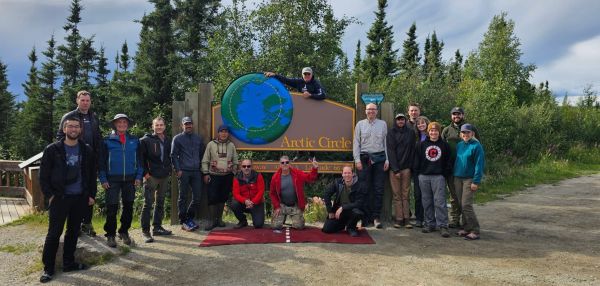
WRB Field Workshop on Cryosols, Alaska, USA, 2026
The 2026 WRB Field Workshop in Alaska focused on the applicability of the WRB classification system in identifying the variation of permafrost-affected soils, as well as on comparing how WRB and USDA Soil Taxonomy approach the naming of these soils. The workshop was held jointly with a regular course (‘Arctic Soils and Permafrost Geography’) offered by the University of Alaska Fairbanks. John Galbraith, Alexander Kholodov, Nick Jelinski, and Megan Andersen provided scientific introductions and highly professional guidance, creating an excellent learning atmosphere.
- Participants examined a selection of mineral and organic soils having permafrost at various depths in their profiles, or affected by permafrost in the past before its degradation launched by human impacts (through changing land use) or climate change.
- Participants examined a selection of mineral and organic soils containing permafrost at various depths, as well as soils affected by permafrost prior to its degradation triggered by human activity (through land-use change) or climate change.
The visited sites represented major climatic and vegetation zones in Alaska, spanning from the boreal forest zone near Fairbanks, through the scenic Brooks Range, and toward the arctic tundra of the North Slope. A globally unique highlight of the trip was the visit to the CRREL Permafrost Research Tunnel in the former Gold Rush area near Fairbanks. The trip confirmed the utility of WRB’s flexible rules in naming permafrost-affected soils, while also highlighting the limitations of certain traditional requirements, particularly regarding the distinction between histic and folic horizons. Furthermore, the trip stimulated discussion on classification criteria for redoximorphic features, B horizons, fluvic properties, and other diagnostic features. The parallel classification demonstrated good correspondence between soil names derived using WRB and USDA Soil Taxonomy, taking into account the fundamental distinction arising from the taxonomic priority of Gelisols over Histosols in Soil Taxonomy.